Entrepreneur • Researcher
building decision infrastructure for women’s health.
I work at the intersection of women’s health, data, and uncertainty—building practical systems that help women make clear, evidence-informed decisions about their bodies, timing, and lives.
WHY THIS MATTERS
Modern women’s health faces a paradox.
Women today have more access than ever to tests, data, and medical information—yet many still feel confused, anxious, or unsupported when making high-stakes decisions.
This gap is not due to a lack of intelligence or effort. It is a systems problem: how information is framed, interpreted, and translated into action under uncertainty.
My work focuses on understanding this gap—and building tools and services that help close it.
WHAT I AM DOING NOW
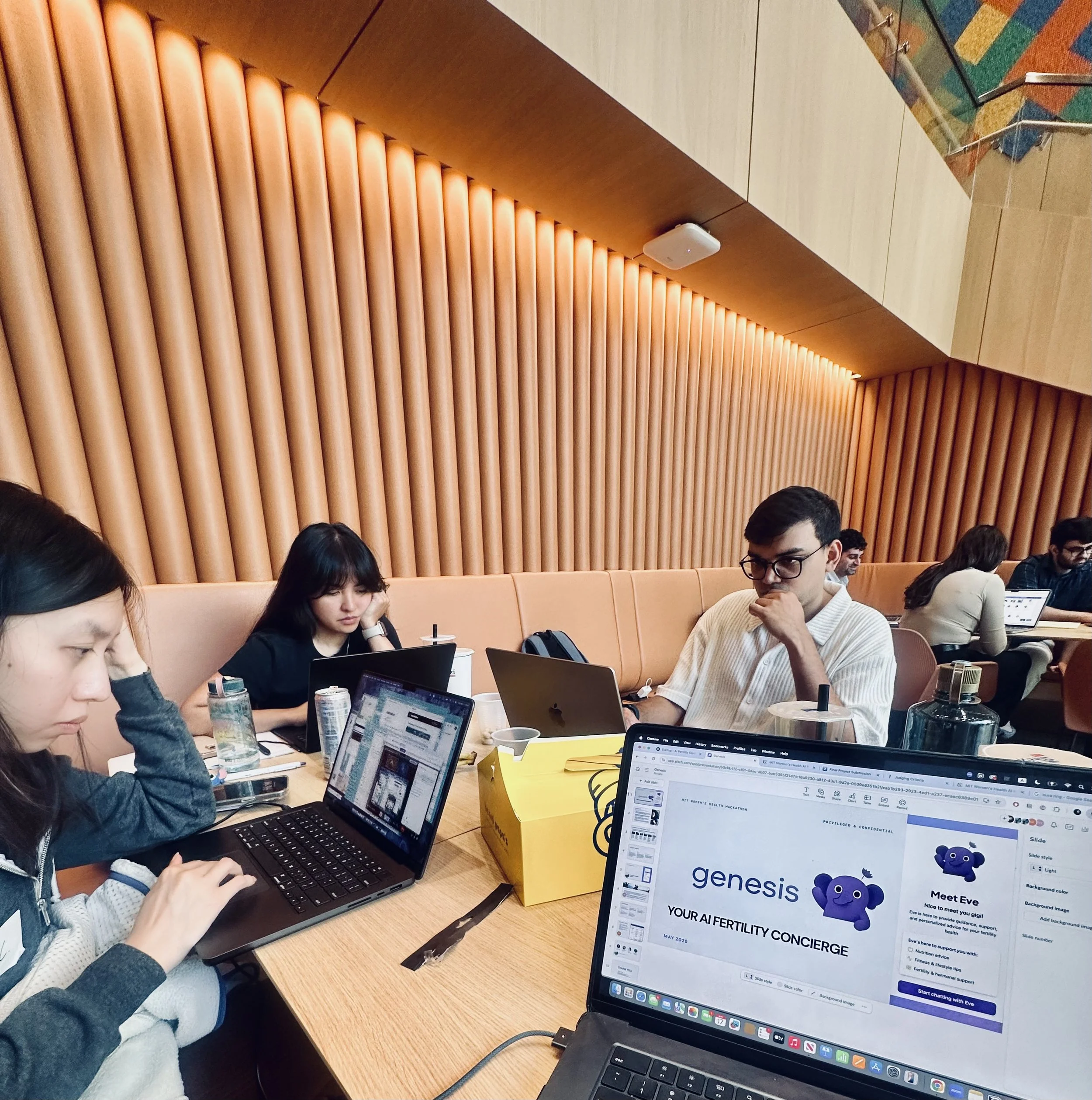
My current work centers on Genesis, an early-stage women’s health venture that functions as an applied research and product lab.
Through Genesis, I study how women:
interpret fertility and hormone information
navigate medical uncertainty
make decisions that intersect with career, relationships, and identity
This work directly informs my academic interests in public health, health behavior, and population-level decision-making.


I am a founder and research-focused practitioner working at the intersection of women’s health, data, and decision-making under uncertainty.
My early career in finance and business strategy trained me to think in systems—how incentives, information, and structure shape outcomes. Over time, this systems lens led me toward a more specific and consequential question: how women make high-stakes health decisions when information is abundant, stakes are personal, and guidance is fragmented.
Today, I am applying this perspective as the founder of Genesis, an early-stage women’s health venture that operates as an applied research and service lab. Through Genesis, I study how women interpret fertility and hormone information, where confusion and anxiety arise, and what kinds of decision support meaningfully improve clarity without unnecessary medicalization.
This work integrates qualitative user research, clinician collaboration, and iterative service design. It has also clarified the need for rigorous training in public health and research methods, which is why I am pursuing advanced study in population health, health behavior, and women’s reproductive health.
My long-term goal is to contribute to both scholarship and practice—building evidence-based systems that help women navigate reproductive health decisions with clarity, dignity, and agency.
About Me
Featured Work
Genesis
Your AI-powered 24/7 fertility co-pilot
Feeling Fertile Newsletter
Weekly insights on women’s health, longevity, and modern ambition.
Research Interests
-
My research focuses on how high-stakes decisions are made under conditions of uncertainty, incomplete information, and irreversible consequences—and how AI-mediated systems reshape judgment, confidence, and outcomes in these environments.
I am particularly interested in decision contexts where data is abundant yet difficult to interpret, incentives are misaligned, and traditional expertise alone does not resolve ambiguity. Across these settings, I study how individuals and institutions integrate algorithmic signals with human judgment, and how system design influences bias, trust, and action.
-
I study how women navigate fertility and reproductive health decisions under medical uncertainty, time pressure, and social constraint. This includes how clinical data, hormonal testing, and AI-enabled tools are interpreted, and how decision support systems can improve clarity, agency, and wellbeing without unnecessary medicalization.
This work is informed by my applied research through Genesis, an early-stage women’s health initiative that functions as a service and research lab for studying real-world decision processes in reproductive health.
-
In parallel, I examine how investors and organizations make capital allocation decisions under extreme uncertainty, and how AI-driven evaluation tools affect judgment, bias, and resource distribution. This stream focuses on venture capital and innovation systems as institutional decision environments where small differences in interpretation can have outsized consequences.
-
How AI-enabled diagnostics and recommendation systems translate complex data into actionable insight—and how their design shapes trust, behavior, and outcomes.
-
How institutional structures, incentives, and system design influence decision quality, access, and equity in both healthcare and financial markets.
Selected Literature Informing My Work
My research is informed by interdisciplinary scholarship spanning reproductive endocrinology, behavioral science, health economics, population health, and the emerging literature on algorithmic decision-making under uncertainty:
Reproductive biology & hormonal variation
Broekmans et al. (2009) — Female reproductive aging
Lizneva et al. (2016) — PCOS overview
Gillies & McArthur (2010) — Estrogen and cognitive function
Sundström-Poromaa & Gingnell (2014) — Hormones & cognition
Stress, behavior, and decision-making
Rooney & Domar (2018) — Stress and infertility
Elliott-Sale et al. (2021) — Menstrual cycle phase & performance
Economic and institutional context
Williams et al. (2021) — Economic cost of menstrual symptoms
Lundborg et al. (2017) — Fertility timing & women’s careers
Chen et al. (2021) — Global fertility decline
Gore et al. (2015) — Endocrine disruptors and women’s health
Algorithmic Decision-Making and Evaluation Under Uncertainty
Agrawal, Gans & Goldfarb (2018) — Prediction Machines
Mullainathan & Obermeyer (2019) — Algorithmic decision-making and bias
Kroll et al. (2017) — Accountability in algorithmic systems
Cowgill (2020) — Bias and productivity in algorithmic hiring / evaluation
Kleinberg et al. (2018) — Human–algorithm collaboration in decision-making
Contact
For academic, research, or collaboration inquiries